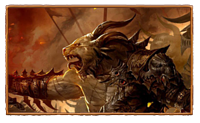
Bestienhorden
Correspondence of translations with another language
Regeln und Ausrüstung der Armee
| DE | EN |
|---|---|
|
Schläfer
Der Spieler kann sich dafür entscheiden, diese Einheit nicht normal aufzustellen und stattdessen den Schläfer zu Beginn einer seiner Verbleibende Bewegungs-Teilphasen zu erwecken: Platziere das Modell vollständig innerhalb eines Waldes.
|
Sleeper
You may choose not to deploy this unit as normal. Instead the controlling player may choose to awaken the Sleeper at the start of any friendly Remaining Moves sub-phase: the Briar Beast is placed completely within any Forests feature on the table.
|
|
Ambush
Before Deployment, after choosing Deployment Zones, an army that includes units with the Ambush special rule must state which of your units with this special rule will use it (starting with the player that picked the Deployment Zone).
Deploy your army as usual, but without deploying any of the Ambushing units. Starting from Game Turn 2, roll a dice for each Ambushing unit at the start of each of your Remaining Moves subphases. After you have rolled for all Ambushing units, each unit that rolled 3+, now enters the Battlefield from any table edge. Place the arriving unit with all of its back rank touching the Board Edge. Ambushing models are free to move in the Remaining Moves subphase, except that they may not March Move, and they must end this Movement Phase no more than twice their Movement value from the Board Edge. If an Ambushing unit has not entered the board (due to failing all its 3+ rolls) before the game ends, the unit counts as destroyed. An Ambushing Character may choose to be deployed within an Ambushing unit that it would normally be allowed to join (declare this when declaring which units are Ambushing). In that case the player rolls once for the combined unit. Until arriving on the Battlefield, Ambushing units cannot do any actions at all, and all items, rules, abilities etc. do not work while not on the Battlefield.
|
Ambush
Before Deployment, after choosing Deployment Zones, an army that includes units with the Ambush special rule must state which of your units with this special rule will use it (starting with the player that picked the Deployment Zone).
Deploy your army as usual, but without deploying any of the Ambushing units. Starting from Game Turn 2, roll a dice for each Ambushing unit at the start of each of your Remaining Moves subphases. After you have rolled for all Ambushing units, each unit that rolled 3+, now enters the Battlefield from any table edge. Place the arriving unit with all of its back rank touching the Board Edge. Ambushing models are free to move in the Remaining Moves subphase, except that they may not March Move, and they must end this Movement Phase no more than twice their Movement value from the Board Edge. If an Ambushing unit has not entered the board (due to failing all its 3+ rolls) before the game ends, the unit counts as destroyed. An Ambushing Character may choose to be deployed within an Ambushing unit that it would normally be allowed to join (declare this when declaring which units are Ambushing). In that case the player rolls once for the combined unit. Until arriving on the Battlefield, Ambushing units cannot do any actions at all, and all items, rules, abilities etc. do not work while not on the Battlefield.
|
|
Halberd
|
Halberd
|
|
Bogen
|
Bow
|
|
Zweihandwaffe
|
Great Weapon
|
|
Schwere Rüstung
|
Heavy Armour
|
|
Light Armour
|
Light Armour
|
|
Riesen-Attacken
Wenn ein Riese im Nahkampf Attacken durchführt, wähle, anstatt normal zu attackieren, eine feindliche Einheit in Basekontakt und würfle auf der unten stehenden Tabelle entsprechend der Truppen- gattung des Ziels.
Gegen Infanterie, Kriegsbestien, Schwärme, Kriegsmaschinen und Kavallerie:
1: Brüllen
2: Springen
3: Greifen
4-6: Schwinger
Gegen Monströse Bestien, Monströse Infanterie, Monströse Kavallerie, Streitwägen, Monster und Gerittene Monster:
1: Brüllen
2-3: Schlag
4-6: Niederschmettern
Brüllen: Weder der Riese noch die ausgewählte Einheit kann in dieser Nahkampfrunde irgendwelche Attacken durchführen. Attacken, die schon durchgeführt wurden oder gleichzeitig mit dieser Attacke stattfinden, sind nicht betroffen. Die Seite des Riesen gewinnt diesenNahkampf automatisch um 2. Wenn in einem Nahkampf zwei(oder mehr) verfeindete Riesen “Brüllen”, zählt der Nahkampf als Unentschieden.
Springen: Die ausgewählte Einheit erleidet W6 Treffer mit der Stärke des Riesen. Der Riese muss einen Testfür Gefährliches Gelände (1) ablegen.
Greifen: Wähle ein einzelnes Modell in Basekontakt mit dem Riesen. Diese Modell muss einen Stärke- und Kampfgeschick-Test ablegen. Für jeden misslungenen Test erhält das Modell einen Treffer mit der Stärke des Riesen und Multiple Lebenspunktverluste (W3).
Schwinger: Der Riese führt 2W6 Attacken gegen die Einheit aus.
Schlag: Wähle ein einzelnes Modell in der Einheit, das sich in Basekontakt mit dem Riesen befindet.Dieses Modell muss einen Initiative Test ablegen. Wenn dieser Test missglückt, erhält das Modell 2W6 Verwundungen mit Rüstungsbrechend (6).
Niederschmettern: Wähle ein einzelnes Modell in der Einheit, das sich in Basekontakt mit dem Riesen befindet. Das Modell erleidet 1 Verwundung mit Rüstungsbrechend (6). Wenn das Modell noch keine Attacken durchgeführt hat, kann es in dieser Runde nicht mehr angreifen. Wenn das Modell schon Attacken durchgeführt hat, kann es stattdessen in der nächsten Kampfrunde nicht angreifen.
- Anmerkung -
Riesen Attacken zählen als Nahkampfattacken und sind dementsprechend von allen Regeln betroffen, die Nahkampfattacken betreffen. Nach dem Würfeln auf der Tabelle kann der Riese immer noch Niedertrampeln.
|
Giant Attacks
When a Beast Giant attacks in Close Combat, instead of attacking normally, choose an enemy unitin base contact with the Beast Giant to attack and roll on the chart below. The Beast Giant’s attack depends on the Troop Type of the target enemy unit.
Against Infantry, War Beast, Swarm, War Machine and Cavalry targets:
1: Bellow
2: Jump
3: Grab
4-6: Swing
Against Monstrous Beast, Monstrous Infantry, Monstrous Cavalry, Chariot, Monster and Ridden Monster targets:
1: Bellow
2-3: Thump
4-6: Smash
Bellow: Neither the Beast Giant nor the chosen unit can make any further Close Combat attacks this phase. Attacks already resolved (including attacks resolved simultaneously with this attack) are not affected. The Beast Giant's side automatically wins the combat by 2. If two (or more) opposing models with Giant Attacks “Bellow”, the combat is a draw.
Jump: The chosen unit suffers D6 hits using the Beast Giant's Strength. The Beast Giant musttake aDangerous Terrain (1) Test.
Grab: Select a single model in the chosen unit and in base contact with the Beast Giant. This model musttake a Strength Test and a Weapon Skill Test. For each failed test, the model suffers a hit with the Beast Giant's Strength and Multiple Wounds (D3).
Swing: The Beast Giant makes 2D6 normal Close Combat attacks against the chosen unit.
Thump: Select a single model in the chosen unit and in base contact with the Beast Giant. This model must take an Initiative Test. If the test is failed, the model suffers 2D6 wounds with Armour Piercing (6).
Smash: Select a single model in the chosen unit and in base contact with the Beast Giant. This model suffers 1wound with Armour Piercing (6). If no part of this model has yet attacked this phase, it cannot attack in this Round of Combat. If the model has already attacked, it cannot make attacks in the following Round of Combat.
- Notes -
Giant Attacks are treated as normal Close Combat attacks and are therefore affected by all rules normally affecting Close Combat attacks. After rolling on this chart, the Beast Giant may still Stomp as normal.
|
|
Divine Attacks
Successful Ward Saves taken against attacks with this special rule, or against Close Combat Attacks made by model parts with this special rule must be rerolled.
|
Divine Attacks
Successful Ward Saves taken against attacks with this special rule, or against Close Combat Attacks made by model parts with this special rule must be rerolled.
|
|
Aura des Wahnsinns
Gegnerische Einheiten im Umkreis von 6” um mindestens ein Modell mit dieser Sonderregel erleiden -1 auf ihren Moralwert.
|
Aura of Madness
Enemy units within 6" of one or more models with Aura of Madness suffer -1 Leadership.
|
|
Aurige Roi des Tombes
|
Aurige Roi des Tombes
|
|
Vanguard
After Deployment (including Scouts), units composed entirely of models with this special rule may perform a 12" move. The move is performed as if in the Remaining Moves subphase, including any actions and restrictions the unit would
normally have in the Remaining Moves subphase (such as Wheeling, Reforming, joining units, leaving units and so on).
The 12" distance is used instead of the unit's Movement Characteristic and no March Moves are allowed. This move cannot be used to move within 12" of enemy units. This is decreased to 6” for enemy units which have either Scouted or
Vanguarded. Units that have moved in this way may not Declare Charges in the first Player Turn (if their side has the first turn). If both players have units with Vanguard, alternate moving units one at a time, starting with the player that
finished deploying last. Instead of moving a unit, a player may declare to not move any more Vangarding units.
|
Vanguard
After Deployment (including Scouts), units composed entirely of models with this special rule may perform a 12" move. The move is performed as if in the Remaining Moves subphase, including any actions and restrictions the unit would
normally have in the Remaining Moves subphase (such as Wheeling, Reforming, joining units, leaving units and so on).
The 12" distance is used instead of the unit's Movement Characteristic and no March Moves are allowed. This move cannot be used to move within 12" of enemy units. This is decreased to 6” for enemy units which have either Scouted or
Vanguarded. Units that have moved in this way may not Declare Charges in the first Player Turn (if their side has the first turn). If both players have units with Vanguard, alternate moving units one at a time, starting with the player that
finished deploying last. Instead of moving a unit, a player may declare to not move any more Vangarding units.
|
|
Trunkenbold
Einheiten mit dieser Sonderregel haben zwei unterschiedliche Regeln, je nachdem ob sieNüchtern oder Betrunken auf dem Schlachtfeld erscheinen.
Nüchtern :
Die Einheit ist ausnahmsweise mal nüchtern und erhält Vorhut und Leichte Truppen. Eine Einheit, die einmal nüchtern war, verliert Punktend für den Rest des Spiels.
Betrunken :
Die Einheit ist Betrunken und erhält Immun gegen Psychologie und Donnernder Angriff. Betrunkene Einheiten können nicht im Hinterhalt aufgestellt werden.
Zu Beginn des Spiels muss der kontrollierende Spieler für jede Trunkenbold-Einheit bestimmen, ob sie Nüchtern oder Betrunken auf dem Schlachtfeld erscheint. Charaktermodelle mit Trunkenbold können sich einer Einheit mit Trunkenbold nur anschließen, wenn diese sich im gleichen Zustand der Nüchternheit (oder Fehlens hiervon) befindet.
|
Drunkard
Units with this rule may gain one of two different sets of effects depending on whether they show up Sober or Drunk on the Battlefield.
Sober:
The Drunkard unit is miraculously sober for once. Sober models gain Vanguard and Light Troops. A unit that has been Sober once loses Scoring for the rest of the game.
Drunk:
The Drunkard unit is unbelievably drunk. Drunk models gain Immune to Psychology and Thunderous Charge. Drunk units cannot Ambush.
The player must choose before the battle whether a Drunkard unit is Sober or Drunk. Drunk Characters cannot join units containing any Sober models, and vice-versa (models without Drunkard are considered neither Drunk or Sober).
|
|
Blood Offering
Units that include at least one Character with this rule may reroll failed Panic Tests at the cost of inflicting one wound with no saves of any kind allowed to a Character with this rule in the unit.
|
Blood Offering
Units that include at least one Character with this rule may reroll failed Panic Tests at the cost of inflicting one wound with no saves of any kind allowed to a Character with this rule in the unit.
|
|
Bodyguard (Beast Lord)
When a Character is joined to an unit with where at least one model has the Bodyguard Special Rule, that Character gains the Stubborn Special Rule. Sometimes this only works with certain Characters. When this is the case, the relevant Characters or Character types will be stated in brackets
|
Bodyguard (Beast Lord)
When a Character is joined to an unit with where at least one model has the Bodyguard Special Rule, that Character gains the Stubborn Special Rule. Sometimes this only works with certain Characters. When this is the case, the relevant Characters or Character types will be stated in brackets
|
|
Geplünderter Schnaps
Nur eine Anwendung. Eine Einheit, die mindestens ein Modell mit dieser Sonderregel enthält, darf am Anfang eines beliebigen Spielerzuges von Nüchtern zu Betrunken wechseln.
|
Looted Booze
One use only. A unit with one or more models with this rule may change from Sober to Drunk at the beginning of any Player Turn.
|
|
Schild
|
Shield
|
|
Stärke durch Fleisch
Immer, wenn der Gortach einen Todesstoß erfolgreich durchführt, erhält die AttackeMultiple Lebenspunktverluste (W3). Wenn diese Attacke mindestens einen unverhinderten Lebenspunktverlust erzielt, heilt der Gortach am Ende des Initiativeschritts einen Lebenspunkt.
|
Strength From Flesh
Whenever a Gortach inflicts an unsaved Lethal Strike (rolling a natural ‘6’to wound with an attack with Lethal Strike), the attack gains Multiple Wounds (D3). If this attack successfully causes one or more unsaved Wounds, the Gortach Recovers 1 Wound at the end of the initiative step.
|
|
Char
|
Char
|
|
Impact Hits (+1)
|
Impact Hits (+1)
|
|
Impact Hits (1)
Impact Hits are Special Close Combat Attacks which can ( and must) only be made in the first Round of Combat after a model with this rule successfully charged into combat. Impact Hits are resolved at Initiative 10 and inflict a number of hits equal to the value stated within brackets (X) to a single enemy unit in base contact, which must be the charged enemy unit. Impact Hits automatically hit and have a Strength value equal to the model's own Strength, with +1
Strength for every Full Rank after the first in the unit, provided that those ranks are comprised entirely of models with the Impact Hits special rule. Due to being Special Attacks, Impact Hits do not benefit from weapon bonuses or special rules. I f a model has both Grinding Attacks and Impact Hits, it may only use one of these rule in the same Combat Round (you may choose which). If the value within brackets is preceded by a ‘+’ sign, add the value to the already existing Impact Hits instead (if the model already had Impact Hits). If not, use the value directly.
In Chariots, only a Chariot itself can use this Special Attack. In the other multipart models only the mounts can use it.
|
Impact Hits (1)
Impact Hits are Special Close Combat Attacks which can ( and must) only be made in the first Round of Combat after a model with this rule successfully charged into combat. Impact Hits are resolved at Initiative 10 and inflict a number of hits equal to the value stated within brackets (X) to a single enemy unit in base contact, which must be the charged enemy unit. Impact Hits automatically hit and have a Strength value equal to the model's own Strength, with +1
Strength for every Full Rank after the first in the unit, provided that those ranks are comprised entirely of models with the Impact Hits special rule. Due to being Special Attacks, Impact Hits do not benefit from weapon bonuses or special rules. I f a model has both Grinding Attacks and Impact Hits, it may only use one of these rule in the same Combat Round (you may choose which). If the value within brackets is preceded by a ‘+’ sign, add the value to the already existing Impact Hits instead (if the model already had Impact Hits). If not, use the value directly.
In Chariots, only a Chariot itself can use this Special Attack. In the other multipart models only the mounts can use it.
|
|
Impact Hits (D3)
Impact Hits are Special Close Combat Attacks which can ( and must) only be made in the first Round of Combat after a model with this rule successfully charged into combat. Impact Hits are resolved at Initiative 10 and inflict a number of hits equal to the value stated within brackets (X) to a single enemy unit in base contact, which must be the charged enemy unit. Impact Hits automatically hit and have a Strength value equal to the model's own Strength, with +1
Strength for every Full Rank after the first in the unit, provided that those ranks are comprised entirely of models with the Impact Hits special rule. Due to being Special Attacks, Impact Hits do not benefit from weapon bonuses or special rules. I f a model has both Grinding Attacks and Impact Hits, it may only use one of these rule in the same Combat Round (you may choose which). If the value within brackets is preceded by a ‘+’ sign, add the value to the already existing Impact Hits instead (if the model already had Impact Hits). If not, use the value directly.
In Chariots, only a Chariot itself can use this Special Attack. In the other multipart models only the mounts can use it.
|
Impact Hits (D3)
Impact Hits are Special Close Combat Attacks which can ( and must) only be made in the first Round of Combat after a model with this rule successfully charged into combat. Impact Hits are resolved at Initiative 10 and inflict a number of hits equal to the value stated within brackets (X) to a single enemy unit in base contact, which must be the charged enemy unit. Impact Hits automatically hit and have a Strength value equal to the model's own Strength, with +1
Strength for every Full Rank after the first in the unit, provided that those ranks are comprised entirely of models with the Impact Hits special rule. Due to being Special Attacks, Impact Hits do not benefit from weapon bonuses or special rules. I f a model has both Grinding Attacks and Impact Hits, it may only use one of these rule in the same Combat Round (you may choose which). If the value within brackets is preceded by a ‘+’ sign, add the value to the already existing Impact Hits instead (if the model already had Impact Hits). If not, use the value directly.
In Chariots, only a Chariot itself can use this Special Attack. In the other multipart models only the mounts can use it.
|
|
Lethal Strike
If an Attack with this special rule, or a Close Combat Attack from a model part with this special rule rolls an unmodified '6' to wound, this Wound has Armour Piercing (6) and Regeneration Saves cannot be taken against it.
|
Lethal Strike
If an Attack with this special rule, or a Close Combat Attack from a model part with this special rule rolls an unmodified '6' to wound, this Wound has Armour Piercing (6) and Regeneration Saves cannot be taken against it.
|
|
Hunting Horn
All friendly units within 6" of one or more models with this special rule gain a +1" modifier to their Charge Range.
|
Hunting Horn
All friendly units within 6" of one or more models with this special rule gain a +1" modifier to their Charge Range.
|
|
Stubborn
A unit with at least one model with this special rule ignores any Combat Score penalties to its Leadership when taking Break Tests or Combat Reform Leadership Tests.
|
Stubborn
A unit with at least one model with this special rule ignores any Combat Score penalties to its Leadership when taking Break Tests or Combat Reform Leadership Tests.
|
|
Innate Defence (4+)
A model can only use one instance of Innate Defence, use the best available Innate Defence. Innate Defence (4+): +3 to Armour Save.
|
Innate Defence (4+)
A model can only use one instance of Innate Defence, use the best available Innate Defence. Innate Defence (4+): +3 to Armour Save.
|
|
Fear
All enemy units in base contact with one or more models with this special rule suffer a 1 Leadership modifier. Models that are Immune to Psychology or that have Fear themselves are immune to the effects of Fear. At the start of each
Combat Round, units in base contact with one or more enemy models with Fear must take a Leadership Test. If this test is failed, the models in the unit have their Weapon Skill reduced to 1 for the remainder of the Combat Round.
|
Fear
All enemy units in base contact with one or more models with this special rule suffer a 1 Leadership modifier. Models that are Immune to Psychology or that have Fear themselves are immune to the effects of Fear. At the start of each
Combat Round, units in base contact with one or more enemy models with Fear must take a Leadership Test. If this test is failed, the models in the unit have their Weapon Skill reduced to 1 for the remainder of the Combat Round.
|
|
Fly (10)
Units composed entirely of models with this special rule can make Flying Movements in the Move Chargers and Remaining Moves sub‐phases. When a unit makes a Flying Movement, substitute the models’ Movement Characteristic with the value given in brackets (X). However, they cannot end their Movement inside or within 1” of a unit or Impassable Terrain (unless charging, when the normal exceptions to the Unit Spacing rule apply). Units using Flying Movement ignore any Terrain or units they fly over from their starting to their ending position, but they are still affected by the effects of the Terrain from which they take off and in which they land. Flying Movement can be used to March. Models with the Fly special rule also always have Swiftstride and Light Troops.
|
Fly (10)
Units composed entirely of models with this special rule can make Flying Movements in the Move Chargers and Remaining Moves sub‐phases. When a unit makes a Flying Movement, substitute the models’ Movement Characteristic with the value given in brackets (X). However, they cannot end their Movement inside or within 1” of a unit or Impassable Terrain (unless charging, when the normal exceptions to the Unit Spacing rule apply). Units using Flying Movement ignore any Terrain or units they fly over from their starting to their ending position, but they are still affected by the effects of the Terrain from which they take off and in which they land. Flying Movement can be used to March. Models with the Fly special rule also always have Swiftstride and Light Troops.
|
|
Fly (8)
Units composed entirely of models with this special rule can make Flying Movements in the Move Chargers and Remaining Moves sub‐phases. When a unit makes a Flying Movement, substitute the models’ Movement Characteristic with the value given in brackets (X). However, they cannot end their Movement inside or within 1” of a unit or Impassable Terrain (unless charging, when the normal exceptions to the Unit Spacing rule apply). Units using Flying Movement ignore any Terrain or units they fly over from their starting to their ending position, but they are still affected by the effects of the Terrain from which they take off and in which they land. Flying Movement can be used to March. Models with the Fly special rule also always have Swiftstride and Light Troops.
|
Fly (8)
Units composed entirely of models with this special rule can make Flying Movements in the Move Chargers and Remaining Moves sub‐phases. When a unit makes a Flying Movement, substitute the models’ Movement Characteristic with the value given in brackets (X). However, they cannot end their Movement inside or within 1” of a unit or Impassable Terrain (unless charging, when the normal exceptions to the Unit Spacing rule apply). Units using Flying Movement ignore any Terrain or units they fly over from their starting to their ending position, but they are still affected by the effects of the Terrain from which they take off and in which they land. Flying Movement can be used to March. Models with the Fly special rule also always have Swiftstride and Light Troops.
|
|
Frenzy
Model parts with Frenzy have +1 Attack and are Immune to Psychology. After all charges have been declared, each of your units with one or more models (or model parts) with Frenzy must take a Frenzy Test (Leadership Test) if it did not
declare a charge. If the test is failed, the unit must declare a charge against the closest viable enemy unit, if there is one.
Characters are never forced to charge out of units. Units with one or more model parts with Frenzy must always pursue and overrun whenever possible. If a model part with Frenzy is ever on the losing side of a Combat Round, it immediately loses this special rule.
|
Frenzy
Model parts with Frenzy have +1 Attack and are Immune to Psychology. After all charges have been declared, each of your units with one or more models (or model parts) with Frenzy must take a Frenzy Test (Leadership Test) if it did not
declare a charge. If the test is failed, the unit must declare a charge against the closest viable enemy unit, if there is one.
Characters are never forced to charge out of units. Units with one or more model parts with Frenzy must always pursue and overrun whenever possible. If a model part with Frenzy is ever on the losing side of a Combat Round, it immediately loses this special rule.
|
|
Pferdebastard
Treffer durch Niedertrampeln können niemals einem Modell mit dieser Regel zugewiesen werden.
|
Half Horse
Stomp hits can never be distributed to a model with this rule.
|
|
Hurl Attack
Catapult (4) Artillery Weapon with: Range 6-36", Strength 3[7], [Multiple Wounds (D3, Clipped Wings)], Magical Attacks, Divine Attacks. A Cyclops that only Pivots (and moves no further) during its owner's Movement Phase ignores the to-hit modifier from Moving and Shooting in the next Shooting Phase.
|
Hurl Attack
Catapult (4) Artillery Weapon with: Range 6-36", Strength 3[7], [Multiple Wounds (D3, Clipped Wings)], Magical Attacks, Divine Attacks. A Cyclops that only Pivots (and moves no further) during its owner's Movement Phase ignores the to-hit modifier from Moving and Shooting in the next Shooting Phase.
|
|
Immune to Psycology
If more than half of a unit's models are Immune to Psychology, the unit automatically passes Panic Tests and cannot declare a Flee reaction (unless already fleeing). Models that are Immune to Psychology are also immune to the effects of Fear.
|
Immune to Psycology
If more than half of a unit's models are Immune to Psychology, the unit automatically passes Panic Tests and cannot declare a Flee reaction (unless already fleeing). Models that are Immune to Psychology are also immune to the effects of Fear.
|
|
Insignificant
Units consisting entirely of models with this special rule do not cause Panic Tests on friendly units without this special rule. Only Insignificant Characters can join units with Insignificant R&F models.
|
Insignificant
Units consisting entirely of models with this special rule do not cause Panic Tests on friendly units without this special rule. Only Insignificant Characters can join units with Insignificant R&F models.
|
|
Urinstinkte
Zu Beginn jederNahkampfrunde müssen alle Einheiten, die ein oder mehrere Modelle mit dieser Sonderregel enthalten, einen Moralwerttest ablegen. Wenn sie diesen Test bestehen, müssen Teile eines Modells mit dieser Sonderregel misslungene Trefferwürfe in dieser Nahkampfrunde wiederholen.
|
Primal Instinct
At the start of each Round of Combat, each unit with one or more models with this special rule must take a Leadership Test. If passed, model parts with this special rule must reroll failed to-hit rolls during that Round of Combat.
|
|
Unbreakable
Units with this special rule are Immune to Psychology and automatically pass all Break Tests. Characters with the Unbreakable special rule can only join Unbreakable units. Unbreakable units can only be joined by Unbreakable
Characters.
|
Unbreakable
Units with this special rule are Immune to Psychology and automatically pass all Break Tests. Characters with the Unbreakable special rule can only join Unbreakable units. Unbreakable units can only be joined by Unbreakable
Characters.
|
|
Leichte Lanze
|
Light Lance
|
|
Légions de Chars
|
Légions de Chars
|
|
Light Troops
Units composed entirely of models with this special rule are allowed to make any number of Reforms when moving in the Remaining Moves subphase, while they may still Advance or March. They are allowed to shoot even if they Marched or Reformed. No model may move more than its Movement allowance (or twice that number if Marching), from its starting position to its final position, around any obstructions (including the Unit Spacing rule). If a model performed any action during the movement (such as Sweeping attacks), the distance moved is counted from its starting position to the point on the Battlefield where it performed that action and then to its final position.If more than half the models in a unit have the Light Troops special rule, the unit always counts as having 0 Full Ranks. Characters with Light Troops that are joined to units with one or more models without Light Troops, lose this rule for as long as it remains with the unit .
|
Light Troops
Units composed entirely of models with this special rule are allowed to make any number of Reforms when moving in the Remaining Moves subphase, while they may still Advance or March. They are allowed to shoot even if they Marched or Reformed. No model may move more than its Movement allowance (or twice that number if Marching), from its starting position to its final position, around any obstructions (including the Unit Spacing rule). If a model performed any action during the movement (such as Sweeping attacks), the distance moved is counted from its starting position to the point on the Battlefield where it performed that action and then to its final position.If more than half the models in a unit have the Light Troops special rule, the unit always counts as having 0 Full Ranks. Characters with Light Troops that are joined to units with one or more models without Light Troops, lose this rule for as long as it remains with the unit .
|
|
Magic Resistance (3)
All models in a unit with one or more models with Magic Resistance add the value within brackets (3) to any Ward Save rolls (using the same rules as for adding to Armour Saves) when rolling Ward Saves against Wounds directly caused by
spell effects. Magic Resistance, like most special rules, is not cumulative. Note that Magic Resistance does not grant Ward Saves for wounds caused indirectly by Spells, such as granting models rules, where this later causes damage.
|
Magic Resistance (3)
All models in a unit with one or more models with Magic Resistance add the value within brackets (3) to any Ward Save rolls (using the same rules as for adding to Armour Saves) when rolling Ward Saves against Wounds directly caused by
spell effects. Magic Resistance, like most special rules, is not cumulative. Note that Magic Resistance does not grant Ward Saves for wounds caused indirectly by Spells, such as granting models rules, where this later causes damage.
|
|
Morts-vivants de Nehekhara
|
Morts-vivants de Nehekhara
|
|
Schutz des Reittieres (5+)
|
Mount’s Protection (5+)
|
|
Random Movement (3D6)
Moves in Compulsory Movements subphase. Always charge, flee, pursue and overrun 3D6.
|
Random Movement (3D6)
Moves in Compulsory Movements subphase. Always charge, flee, pursue and overrun 3D6.
|
|
Rudelverhalten
Modelle mit dieser Sonderregel erhalten Schnelle Bewegung, solange sie einen Angriff in die Flanke oder den Rücken einer gegnerischen Einheit durchführen. Dies gilt nicht für Verfolgungsbewegungen.
|
Pack Tactics
Models with this rule gain Swiftstride as long as their unit is charging into an enemy unit ’s flank or rear.
|
|
Poisoned Attacks
If an attack with this special rule, or an attack from a model part with this special rule (both Shooting and Close Combat Attacks), rolls a successful hit with a tohit
roll of an unmodified '6', this hit automatically wounds with no to wound roll needed. Shooting Attacks that need a 7+ to hit (or more) can never benefit from Poisoned Attacks. If the Attack can be turned into more than one hit (such as for a hit with Penetrating or Area Attack), only a single hit (of attacker’s choice)
automatically wounds, all other hits must roll to wound as normal.
|
Poisoned Attacks
If an attack with this special rule, or an attack from a model part with this special rule (both Shooting and Close Combat Attacks), rolls a successful hit with a tohit
roll of an unmodified '6', this hit automatically wounds with no to wound roll needed. Shooting Attacks that need a 7+ to hit (or more) can never benefit from Poisoned Attacks. If the Attack can be turned into more than one hit (such as for a hit with Penetrating or Area Attack), only a single hit (of attacker’s choice)
automatically wounds, all other hits must roll to wound as normal.
|
|
Scoring
Units with at least one model with the Scoring special rule are considered Scoring Units and are used for capturing Secondary Objectives. Every army needs a few Scoring units to be able to complete Secondary Objectives, which is why units with the Scoring special rule are marked in the Armybooks with a special pennant icon:
The Scoring special rule can be lost during the game:
● One or more models in the unit are Light Troops.
● A unit that is Fleeing loses its Scoring special rule for as long as it if Fleeing.
● An Ambushing unit that entered the Battlefield on Game Turn 4 or later loses its Scoring Special rule.
● A unit that has performed a Post-Combat Reform loses its Scoring special rule until the end of the current
Player Turn.
|
Scoring
Units with at least one model with the Scoring special rule are considered Scoring Units and are used for capturing Secondary Objectives. Every army needs a few Scoring units to be able to complete Secondary Objectives, which is why units with the Scoring special rule are marked in the Armybooks with a special pennant icon:
The Scoring special rule can be lost during the game:
● One or more models in the unit are Light Troops.
● A unit that is Fleeing loses its Scoring special rule for as long as it if Fleeing.
● An Ambushing unit that entered the Battlefield on Game Turn 4 or later loses its Scoring Special rule.
● A unit that has performed a Post-Combat Reform loses its Scoring special rule until the end of the current
Player Turn.
|
|
Pur-Sang
|
Pur-Sang
|
|
Random Attacks (1D6+1)
A model part with this rule has a random number of Attacks equal to the value between brackets (before adding possible modifier to it). For example, a model with Random Attacks (D3+2) can have between 3 and 5 Attacks. These attacks ignore the limit which states that a model may have a maximum of 10 attacks.
|
Random Attacks (1D6+1)
A model part with this rule has a random number of Attacks equal to the value between brackets (before adding possible modifier to it). For example, a model with Random Attacks (D3+2) can have between 3 and 5 Attacks. These attacks ignore the limit which states that a model may have a maximum of 10 attacks.
|
|
Skirmishers
Models with this special rule always gain Light Troops. Shooting at Skirmishers suffers a -1 to-hit modifier.
Skirmishing models are not placed in base to base contact with each other. Instead, models are placed with a 12.5mm distance between them. This gap is considered part of the unit for Line of Sight purposes, and will have the same Height as the largest fraction of the models in the unit. Other than this gap between models, units of Skirmishers follow the normal rules for forming units and therefore have a front, two flanks, a rear, can perform Supporting Attacks from the second rank, and so on . Skirmishing units can only be joined by Characters that have the same Troop Type as the unit. A Character which joins a unit of Skirmishers gains Skirmishers for as long as it remains with the unit. The unit ceases to be Skirmishers if all models with Skirmishers are wiped out, immediately contracting their loose formation into a normal formation, without moving the centre of the front rank. Nudge any unit as normal to maintain base contact when possible . The Character is always considered Mismatched for the purpose of placement within the unit unless it has the exact same base size as the other Skirmisher models.
|
Skirmishers
Models with this special rule always gain Light Troops. Shooting at Skirmishers suffers a -1 to-hit modifier.
Skirmishing models are not placed in base to base contact with each other. Instead, models are placed with a 12.5mm distance between them. This gap is considered part of the unit for Line of Sight purposes, and will have the same Height as the largest fraction of the models in the unit. Other than this gap between models, units of Skirmishers follow the normal rules for forming units and therefore have a front, two flanks, a rear, can perform Supporting Attacks from the second rank, and so on . Skirmishing units can only be joined by Characters that have the same Troop Type as the unit. A Character which joins a unit of Skirmishers gains Skirmishers for as long as it remains with the unit. The unit ceases to be Skirmishers if all models with Skirmishers are wiped out, immediately contracting their loose formation into a normal formation, without moving the centre of the front rank. Nudge any unit as normal to maintain base contact when possible . The Character is always considered Mismatched for the purpose of placement within the unit unless it has the exact same base size as the other Skirmisher models.
|
|
Strider (Forest)
Models with this special rule may ignore any movement effect caused by Terrain except Impassable Terrain and Buildings and never lose their Steadfast or Rank Bonus due to Terrain. Sometimes this special rule is only linked to a specific type of Terrain, stated in brackets. In this case, the Strider rule effectis only applied in relation to the specified Terrain type.
|
Strider (Forest)
Models with this special rule may ignore any movement effect caused by Terrain except Impassable Terrain and Buildings and never lose their Steadfast or Rank Bonus due to Terrain. Sometimes this special rule is only linked to a specific type of Terrain, stated in brackets. In this case, the Strider rule effectis only applied in relation to the specified Terrain type.
|
|
Thunderous Charge
In the first round of a combat after a model with this rule has successfully charged, model parts with this special rule receive a +1 Strength bonus to their normal Close Combat Attacks. This Strength bonus can only be used for Attacks directed against the charged enemies.
|
Thunderous Charge
In the first round of a combat after a model with this rule has successfully charged, model parts with this special rule receive a +1 Strength bonus to their normal Close Combat Attacks. This Strength bonus can only be used for Attacks directed against the charged enemies.
|
|
Ward Save (5+)
Ward Saves are special saves, taken after failed Armour Saves. The value of the save will be stated in brackets. Ward Saves cannot be taken alongside Regeneration Saves (if a model has both, it must choose which one to use).
|
Ward Save (5+)
Ward Saves are special saves, taken after failed Armour Saves. The value of the save will be stated in brackets. Ward Saves cannot be taken alongside Regeneration Saves (if a model has both, it must choose which one to use).
|
|
Wizard Apprentice with 1 learned spell
|
Wizard Apprentice with 1 learned spell
|
Magische Gegenstände der Armee
| DE | EN |
|---|
Magische Banner der Armee
| DE | EN |
|---|---|
|
Aether Icon
The bearer can make Dispel Attempts as if it was a Wizard Master.
|
Aether Icon
The bearer can make Dispel Attempts as if it was a Wizard Master.
|
|
Banner of Discipline
The bearer's unit automatically passes all Panic Tests.
|
Banner of Discipline
The bearer's unit automatically passes all Panic Tests.
|
|
Banner of Speed
The bearer's unit gains +1 Movement.
|
Banner of Speed
The bearer's unit gains +1 Movement.
|
|
Rending Banner
All non-character models in the bearer’s unit gain Armour Piercing (1).
|
Rending Banner
All non-character models in the bearer’s unit gain Armour Piercing (1).
|
|
War Standard
The bearer's unit adds +1 to the Combat Score of any combat they are involved in.
|
War Standard
The bearer's unit adds +1 to the Combat Score of any combat they are involved in.
|
|
Stalker's Standard
The bearer’s unit gains Strider and Swiftstride.
|
Stalker's Standard
The bearer’s unit gains Strider and Swiftstride.
|
|
Flaming Standard
The bearer's unit automatically passes all Panic Tests.
|
Flaming Standard
The bearer's unit automatically passes all Panic Tests.
|
|
Gleaming Icon
One use only. Must be activated the first time the bearer's unit fails a Leadership Test. The unit may reroll the failed test.
|
Gleaming Icon
One use only. Must be activated the first time the bearer's unit fails a Leadership Test. The unit may reroll the failed test.
|
|
Icon of the Relentless Company
One use only. Activate at the start of any of your Remaining Moves sub-phases. Infantry models in the bearer's unit can triple its Movement when Marching instead of doubling it this turn. This March Move cannot be longer than 15" and cannot be used in Game Turn 1 if the unit has used Vanguard or Scout.
|
Icon of the Relentless Company
One use only. Activate at the start of any of your Remaining Moves sub-phases. Infantry models in the bearer's unit can triple its Movement when Marching instead of doubling it this turn. This March Move cannot be longer than 15" and cannot be used in Game Turn 1 if the unit has used Vanguard or Scout.
|