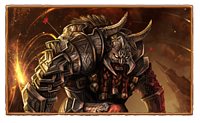
Nains Infernaux
Correspondance des traductions avec la VO
Règles et Équipements utilisés par l'armée
| FR | EN |
|---|---|
|
Volcanic Embrace
All attacks made by a model part with this special rule (even Special Attacks) gain Flaming Attacks. In addition, in each Round of Combat, all enemy models in base contact with one or more models with this rule suffer a Strength 4 hit with Flaming Attacks at Initiative 0. This is a Special Close Combat Attack.
|
Volcanic Embrace
All attacks made by a model part with this special rule (even Special Attacks) gain Flaming Attacks. In addition, in each Round of Combat, all enemy models in base contact with one or more models with this rule suffer a Strength 4 hit with Flaming Attacks at Initiative 0. This is a Special Close Combat Attack.
|
|
Fan the Flames
The Overlord and all model parts in the same unit, except mounts, gain Hatred.
|
Fan the Flames
The Overlord and all model parts in the same unit, except mounts, gain Hatred.
|
|
Arme Lourde
|
Great Weapon
|
|
Armure Lourde
|
Heavy Armour
|
|
Paire d'Armes
|
Paired Weapons
|
|
Infernal Armour
Plate Armour. The wearer gains a Ward Save (5+) against Flaming Attacks.
|
Infernal Armour
Plate Armour. The wearer gains a Ward Save (5+) against Flaming Attacks.
|
|
Armure Légère
|
Light Armour
|
|
Attaques de Géant
Quand un Géant attaque au Corps àCorps, au lieu d’attaquer normalement, choisissez une unité en contact socle à socle à attaquer et lancez 1D6. Déterminez ci‐dessous la table à utiliser selon le Type de Troupe de l’unité visée, et trouvez l’attaque correspondant au résultat du dé. Il est important de noter que les Attaques de Géant comptent comme des Attaques de Corps à Corps et suivent ainsi normalement les règles affectant ces attaques. Le Géant peut également faire son Piétinement.
Si l’unité est de type Infanterie, Bête de Guerre, Cavalerie, Nuée ou Machine de Guerre :
1 : Hurle
2 : Saute
3 : Ramasse
46 : Frappe
Si l’unité est de type Infanterie Monstrueuse, Cavalerie Monstrueuse, Bête Monstrueuse, Char, Monstre ou Monstre Monté:
1 : Hurle
23 : Tape comme un Sourd
46 : Fracasse
Hurle : Ni le Géant, ni l’unité sélectionnée ne peuvent faire d’Attaques de Corps à Corps pendant cette phase. Les attaques déjà réalisées, incluant celles réalisées simultanément avec cette attaque, ne sont pas concernées. Le camp du Géant gagne automatiquement le combat avec un résultat de 2. Si deux Géants opposés, ou plus, utilisent l’attaque Hurle, le combat est un match nul.
Saute : L’unité sélectionnée subit 1D6 touches de la Force du Géant. Le Géant doit faire un test de Terrain Dangereux.
Ramasse : Choisissez une figurine dans l’unité sélectionnée et en contact socle à socle avec le Géant. Cette figurine doit faire un test de Force et un test de Capacité de Combat. Pour chaque test raté, la figurine subit une touche de la Force du Géant et suivant la règle spéciale Blessures Multiples (1D3).
Frappe : Le Géant fait 2D6 attaques contre l’unité choisie.
Tape comme un Sourd : Choisissez une figurine en contact socle à socle avec le Géant dans l’unité sélectionnée. Cette figurine doit faire un test d’Initiative. Si elle échoue, la figurine subit 2D6 blessures avec Perforant (6).
Fracasse : Choisissez une figurine en contact socle à socle avec le Géant dans l’unité sélectionnée. Cette figurine subit une blessure avec Perforant (6). Si la figurine n’a pas encore attaqué, elle ne peut pas le faire au cours de cette manche. Si la figurine a déjà réalisé ses attaques, elle ne pourra pas attaquer au cours du Tour de Joueur à venir.
|
Giant Attacks
When a Beast Giant attacks in Close Combat, instead of attacking normally, choose an enemy unitin base contact with the Beast Giant to attack and roll on the chart below. The Beast Giant’s attack depends on the Troop Type of the target enemy unit.
Against Infantry, War Beast, Swarm, War Machine and Cavalry targets:
1: Bellow
2: Jump
3: Grab
4-6: Swing
Against Monstrous Beast, Monstrous Infantry, Monstrous Cavalry, Chariot, Monster and Ridden Monster targets:
1: Bellow
2-3: Thump
4-6: Smash
Bellow: Neither the Beast Giant nor the chosen unit can make any further Close Combat attacks this phase. Attacks already resolved (including attacks resolved simultaneously with this attack) are not affected. The Beast Giant's side automatically wins the combat by 2. If two (or more) opposing models with Giant Attacks “Bellow”, the combat is a draw.
Jump: The chosen unit suffers D6 hits using the Beast Giant's Strength. The Beast Giant musttake aDangerous Terrain (1) Test.
Grab: Select a single model in the chosen unit and in base contact with the Beast Giant. This model musttake a Strength Test and a Weapon Skill Test. For each failed test, the model suffers a hit with the Beast Giant's Strength and Multiple Wounds (D3).
Swing: The Beast Giant makes 2D6 normal Close Combat attacks against the chosen unit.
Thump: Select a single model in the chosen unit and in base contact with the Beast Giant. This model must take an Initiative Test. If the test is failed, the model suffers 2D6 wounds with Armour Piercing (6).
Smash: Select a single model in the chosen unit and in base contact with the Beast Giant. This model suffers 1wound with Armour Piercing (6). If no part of this model has yet attacked this phase, it cannot attack in this Round of Combat. If the model has already attacked, it cannot make attacks in the following Round of Combat.
- Notes -
Giant Attacks are treated as normal Close Combat attacks and are therefore affected by all rules normally affecting Close Combat attacks. After rolling on this chart, the Beast Giant may still Stomp as normal.
|
|
Magical Attacks
Attacks with this special rule or Attacks made by model parts with this special rule normally don’t have any special effect. However, they interact with other rules (such as Ethereal). Models with this special rule apply it to all their attacks, including Special Attacks such as Stomp, Impact Hits, and Breath Attacks (unless stated otherwise).All attacks caused by spells and Magical Items have Magical Attacks .
|
Magical Attacks
Attacks with this special rule or Attacks made by model parts with this special rule normally don’t have any special effect. However, they interact with other rules (such as Ethereal). Models with this special rule apply it to all their attacks, including Special Attacks such as Stomp, Impact Hits, and Breath Attacks (unless stated otherwise).All attacks caused by spells and Magical Items have Magical Attacks .
|
|
Aura of Unbinding
Any Magical Weapon wielded by models (friend or foe) in base contact with a Lammasu becomes a mundane weapon of the same type. This effect lasts for as long as models remain in base contact. A Character riding a Lamassu is unaffected.
|
Aura of Unbinding
Any Magical Weapon wielded by models (friend or foe) in base contact with a Lammasu becomes a mundane weapon of the same type. This effect lasts for as long as models remain in base contact. A Character riding a Lamassu is unaffected.
|
|
Blessing of Nezibkesh
All Special Close Combat Attacks against models with this special rule are at half Strength (rounding fractions up).
|
Blessing of Nezibkesh
All Special Close Combat Attacks against models with this special rule are at half Strength (rounding fractions up).
|
|
Hard Target
Shooting Attacks targeting a unit in which more than half of models have this special rule suffer a -1 penalty when rolling to hit.
|
Hard Target
Shooting Attacks targeting a unit in which more than half of models have this special rule suffer a -1 penalty when rolling to hit.
|
|
Bodyguard
When a Character is joined to a unit in which at least one model has the Bodyguard special rule, that Character gains
Stubborn. When Characters or Character types are stated in brackets, Bodyguard only works for the specified
Characters or Character types.
|
Bodyguard
When a Character is joined to a unit in which at least one model has the Bodyguard special rule, that Character gains
Stubborn. When Characters or Character types are stated in brackets, Bodyguard only works for the specified
Characters or Character types.
|
|
Bolt Thrower Artillery Weapon
Type: Paired Weapons. The wielder gains +1 Armour Save, unless using another weapon. The wielder also gains Parry, and can use it even with a magical Iron Fist, and even when riding a mount that is not a Monster or a Ridden Monster.
|
Bolt Thrower Artillery Weapon
Type: Paired Weapons. The wielder gains +1 Armour Save, unless using another weapon. The wielder also gains Parry, and can use it even with a magical Iron Fist, and even when riding a mount that is not a Monster or a Ridden Monster.
|
|
Born to Fight
Model parts with this special rule gain +1 Strength in the first Round of Combat.
|
Born to Fight
Model parts with this special rule gain +1 Strength in the first Round of Combat.
|
|
Bouclier
|
Shield
|
|
Breath Weapon (Strength 4, Flaming Attacks)
|
Breath Weapon (Strength 4, Flaming Attacks)
|
|
Chosen of Ashuruk
Models with this special rule will automatically pass all Fear Tests, but still suffer -1 Leadership from Fear. Models with this special rule consider all units without it to have Insignificant and cannot use their Engineer rule on models without Chosen of Ashuruk.
|
Chosen of Ashuruk
Models with this special rule will automatically pass all Fear Tests, but still suffer -1 Leadership from Fear. Models with this special rule consider all units without it to have Insignificant and cannot use their Engineer rule on models without Chosen of Ashuruk.
|
|
Searing Rage
Each time the model fails a Frenzy test it adds +1 Attack to the additional attacks granted by Frenzy. If Frenzy is lost then so are these additional attacks.
|
Searing Rage
Each time the model fails a Frenzy test it adds +1 Attack to the additional attacks granted by Frenzy. If Frenzy is lost then so are these additional attacks.
|
|
Impact Hits (+1)
|
Impact Hits (+1)
|
|
Daemonic Fury
At the beginning of each friendly Player Turn, the Bound Daemon must take a Leadership Test. If the test is failed, the Bound Daemon gains Random Movement (3D6) until the end of the Player Turn, and must move towards the closest enemy unit in the Movement Phase.
|
Daemonic Fury
At the beginning of each friendly Player Turn, the Bound Daemon must take a Leadership Test. If the test is failed, the Bound Daemon gains Random Movement (3D6) until the end of the Player Turn, and must move towards the closest enemy unit in the Movement Phase.
|
|
Daemonic Infusion
A model part with this special rule gains Magical Attacks (not applicable to crew), and any Panic Test it causes to enemy units through 25% casualties suffers a -1 Leadership modifier.
|
Daemonic Infusion
A model part with this special rule gains Magical Attacks (not applicable to crew), and any Panic Test it causes to enemy units through 25% casualties suffers a -1 Leadership modifier.
|
|
Daemonic Instability
When a unit with this Special Rule fails a Break Test, it does not flee from combat. Instead, it suffers a number of Wounds equal to the amount by which the test was failed (Simplified formula: 2D6+CSLd), ignoring the usual minimum 0 for its Leadership Characteristic. These Wounds are distributed following the rules for Unstable, with no saves of any kind allowed. Only characters with Daemonic Instability can join units with Daemonic Instability, and Characters with Daemonic Instability cannot join units without Daemonic Instability. If a model has both Daemonic Instability and Unstable, disregard the latter.
|
Daemonic Instability
When a unit with this Special Rule fails a Break Test, it does not flee from combat. Instead, it suffers a number of Wounds equal to the amount by which the test was failed (Simplified formula: 2D6+CSLd), ignoring the usual minimum 0 for its Leadership Characteristic. These Wounds are distributed following the rules for Unstable, with no saves of any kind allowed. Only characters with Daemonic Instability can join units with Daemonic Instability, and Characters with Daemonic Instability cannot join units without Daemonic Instability. If a model has both Daemonic Instability and Unstable, disregard the latter.
|
|
Daemonic Possesion
The model gains Frenzy and can never lose it.
|
Daemonic Possesion
The model gains Frenzy and can never lose it.
|
|
Stubborn
A unit with at least one model with this special rule ignores any Combat Score penalties to its Leadership when taking Break Tests or Combat Reform Leadership Tests.
|
Stubborn
A unit with at least one model with this special rule ignores any Combat Score penalties to its Leadership when taking Break Tests or Combat Reform Leadership Tests.
|
|
Innate Defence (3+)
A model can only use one instance of Innate Defence, use the best available Innate Defence. Innate Defence (3+): +2 to Armour Save.
|
Innate Defence (3+)
A model can only use one instance of Innate Defence, use the best available Innate Defence. Innate Defence (3+): +2 to Armour Save.
|
|
Innate Defence (5+)
A model can only use one instance of Innate Defence, use the best available Innate Defence. Innate Defence (5+): +4 to Armour Save.
|
Innate Defence (5+)
A model can only use one instance of Innate Defence, use the best available Innate Defence. Innate Defence (5+): +4 to Armour Save.
|
|
Earthquake Shells
Any unit that suffers one or more unsaved wounds from a weapon with this rule will count all Terrain (including Open Terrain) as Dangerous Terrain (1) and must reroll to-hit rolls of '6'. A War Machine within 8" of a unit hit by a Shooting Attack from a model with this special rule must roll a D6 before shooting; on 4+ it cannot shoot. These effects last until the end of the next Player Turn.
|
Earthquake Shells
Any unit that suffers one or more unsaved wounds from a weapon with this rule will count all Terrain (including Open Terrain) as Dangerous Terrain (1) and must reroll to-hit rolls of '6'. A War Machine within 8" of a unit hit by a Shooting Attack from a model with this special rule must roll a D6 before shooting; on 4+ it cannot shoot. These effects last until the end of the next Player Turn.
|
|
Engineer
A model with this special rule allows a War Machine within 3" to use the Engineer's Ballistic Skill instead of its own and to reroll any rolls on the Misfire Table. (If there are several War Machines within 3" of the Engineer, declare which one will receive the Engineer's benefits this Player Turn before firing it). If the War Machine uses a Flame Thrower Artillery Weapon, all D3 rolls for the number of hits the Flame Cannon scores on its target may be rerolled.
If this is used, you must either reroll all dice or none.
This rule cannot be used by a model that is Engaged in Combat.
|
Engineer
A model with this special rule allows a War Machine within 3" to use the Engineer's Ballistic Skill instead of its own and to reroll any rolls on the Misfire Table. (If there are several War Machines within 3" of the Engineer, declare which one will receive the Engineer's benefits this Player Turn before firing it). If the War Machine uses a Flame Thrower Artillery Weapon, all D3 rolls for the number of hits the Flame Cannon scores on its target may be rerolled.
If this is used, you must either reroll all dice or none.
This rule cannot be used by a model that is Engaged in Combat.
|
|
Fast Cavalry
Models with this special rule have Light Troops and Vanguard. If a unit consisting solely of models with Fast Cavalry voluntarily flees as a Charge Reaction and subsequently rallies the next friendly Player Turn, then the unit may move
and shoot during that Player Turn. The rallied unit may not charge and counts as having moved for the purpose of shooting. This rule cannot be applied if a unit fails to rally on the next friendly Player or involuntarily flees, such as a result of a failed Panic Test.
|
Fast Cavalry
Models with this special rule have Light Troops and Vanguard. If a unit consisting solely of models with Fast Cavalry voluntarily flees as a Charge Reaction and subsequently rallies the next friendly Player Turn, then the unit may move
and shoot during that Player Turn. The rallied unit may not charge and counts as having moved for the purpose of shooting. This rule cannot be applied if a unit fails to rally on the next friendly Player or involuntarily flees, such as a result of a failed Panic Test.
|
|
Fear
All enemy units in base contact with one or more models with this special rule suffer a 1 Leadership modifier. Models that are Immune to Psychology or that have Fear themselves are immune to the effects of Fear. At the start of each
Combat Round, units in base contact with one or more enemy models with Fear must take a Leadership Test. If this test is failed, the models in the unit have their Weapon Skill reduced to 1 for the remainder of the Combat Round.
|
Fear
All enemy units in base contact with one or more models with this special rule suffer a 1 Leadership modifier. Models that are Immune to Psychology or that have Fear themselves are immune to the effects of Fear. At the start of each
Combat Round, units in base contact with one or more enemy models with Fear must take a Leadership Test. If this test is failed, the models in the unit have their Weapon Skill reduced to 1 for the remainder of the Combat Round.
|
|
Fireborn
Model parts with this special rule have a Ward Save (2+) against Flaming Attacks. While a model has Fireborn, it cannot benefit from Regeneration.
|
Fireborn
Model parts with this special rule have a Ward Save (2+) against Flaming Attacks. While a model has Fireborn, it cannot benefit from Regeneration.
|
|
Fly (6)
Units composed entirely of models with this special rule can make Flying Movements in the Move Chargers and Remaining Moves sub‐phases. When a unit makes a Flying Movement, substitute the models’ Movement Characteristic with the value given in brackets (X). However, they cannot end their Movement inside or within 1” of a unit or Impassable Terrain (unless charging, when the normal exceptions to the Unit Spacing rule apply). Units using Flying Movement ignore any Terrain or units they fly over from their starting to their ending position, but they are still affected by the effects of the Terrain from which they take off and in which they land. Flying Movement can be used to March. Models with the Fly special rule also always have Swiftstride and Light Troops.
|
Fly (6)
Units composed entirely of models with this special rule can make Flying Movements in the Move Chargers and Remaining Moves sub‐phases. When a unit makes a Flying Movement, substitute the models’ Movement Characteristic with the value given in brackets (X). However, they cannot end their Movement inside or within 1” of a unit or Impassable Terrain (unless charging, when the normal exceptions to the Unit Spacing rule apply). Units using Flying Movement ignore any Terrain or units they fly over from their starting to their ending position, but they are still affected by the effects of the Terrain from which they take off and in which they land. Flying Movement can be used to March. Models with the Fly special rule also always have Swiftstride and Light Troops.
|
|
Fly (7)
Units composed entirely of models with this special rule can make Flying Movements in the Move Chargers and Remaining Moves sub‐phases. When a unit makes a Flying Movement, substitute the models’ Movement Characteristic with the value given in brackets (X). However, they cannot end their Movement inside or within 1” of a unit or Impassable Terrain (unless charging, when the normal exceptions to the Unit Spacing rule apply). Units using Flying Movement ignore any Terrain or units they fly over from their starting to their ending position, but they are still affected by the effects of the Terrain from which they take off and in which they land. Flying Movement can be used to March. Models with the Fly special rule also always have Swiftstride and Light Troops.
|
Fly (7)
Units composed entirely of models with this special rule can make Flying Movements in the Move Chargers and Remaining Moves sub‐phases. When a unit makes a Flying Movement, substitute the models’ Movement Characteristic with the value given in brackets (X). However, they cannot end their Movement inside or within 1” of a unit or Impassable Terrain (unless charging, when the normal exceptions to the Unit Spacing rule apply). Units using Flying Movement ignore any Terrain or units they fly over from their starting to their ending position, but they are still affected by the effects of the Terrain from which they take off and in which they land. Flying Movement can be used to March. Models with the Fly special rule also always have Swiftstride and Light Troops.
|
|
Fly (8)
Units composed entirely of models with this special rule can make Flying Movements in the Move Chargers and Remaining Moves sub‐phases. When a unit makes a Flying Movement, substitute the models’ Movement Characteristic with the value given in brackets (X). However, they cannot end their Movement inside or within 1” of a unit or Impassable Terrain (unless charging, when the normal exceptions to the Unit Spacing rule apply). Units using Flying Movement ignore any Terrain or units they fly over from their starting to their ending position, but they are still affected by the effects of the Terrain from which they take off and in which they land. Flying Movement can be used to March. Models with the Fly special rule also always have Swiftstride and Light Troops.
|
Fly (8)
Units composed entirely of models with this special rule can make Flying Movements in the Move Chargers and Remaining Moves sub‐phases. When a unit makes a Flying Movement, substitute the models’ Movement Characteristic with the value given in brackets (X). However, they cannot end their Movement inside or within 1” of a unit or Impassable Terrain (unless charging, when the normal exceptions to the Unit Spacing rule apply). Units using Flying Movement ignore any Terrain or units they fly over from their starting to their ending position, but they are still affected by the effects of the Terrain from which they take off and in which they land. Flying Movement can be used to March. Models with the Fly special rule also always have Swiftstride and Light Troops.
|
|
Frenzy
Model parts with Frenzy have +1 Attack and are Immune to Psychology. After all charges have been declared, each of your units with one or more models (or model parts) with Frenzy must take a Frenzy Test (Leadership Test) if it did not
declare a charge. If the test is failed, the unit must declare a charge against the closest viable enemy unit, if there is one.
Characters are never forced to charge out of units. Units with one or more model parts with Frenzy must always pursue and overrun whenever possible. If a model part with Frenzy is ever on the losing side of a Combat Round, it immediately loses this special rule.
|
Frenzy
Model parts with Frenzy have +1 Attack and are Immune to Psychology. After all charges have been declared, each of your units with one or more models (or model parts) with Frenzy must take a Frenzy Test (Leadership Test) if it did not
declare a charge. If the test is failed, the unit must declare a charge against the closest viable enemy unit, if there is one.
Characters are never forced to charge out of units. Units with one or more model parts with Frenzy must always pursue and overrun whenever possible. If a model part with Frenzy is ever on the losing side of a Combat Round, it immediately loses this special rule.
|
|
Full Steam Ahead!
During the Compulsory Moves sub-phase,the Infernal Engine may optto engage its boiler.If it does so, for until the end of this Player Turn the unit may not shoot and gains Random Movement(3D6), with the following exception: it cannot move into base contact with a unit that was not within the Infernal Engine’s Front Arc before the initial pivot.
|
Full Steam Ahead!
During the Compulsory Moves sub-phase,the Infernal Engine may optto engage its boiler.If it does so, for until the end of this Player Turn the unit may not shoot and gains Random Movement(3D6), with the following exception: it cannot move into base contact with a unit that was not within the Infernal Engine’s Front Arc before the initial pivot.
|
|
Grinding Attacks (D3)
Close Combat Attack at its own Initiative against a single enemy Unit in base contact. This attack deals a number of hits equal to the value stated within brackets (D3). These automatically hit and have a Strength equal to the model's own Strength. Can never benefit from equipment or Special Ruls. If a model has both Grinding Attacks and Impact Hits, it may only use one of these rule in the same combat phase.
|
Grinding Attacks (D3)
Close Combat Attack at its own Initiative against a single enemy Unit in base contact. This attack deals a number of hits equal to the value stated within brackets (D3). These automatically hit and have a Strength equal to the model's own Strength. Can never benefit from equipment or Special Ruls. If a model has both Grinding Attacks and Impact Hits, it may only use one of these rule in the same combat phase.
|
|
Half Bull
Stomp hits can never be distributed onto a model with this special rule.
|
Half Bull
Stomp hits can never be distributed onto a model with this special rule.
|
|
Immune to Psycology
If more than half of a unit's models are Immune to Psychology, the unit automatically passes Panic Tests and cannot declare a Flee reaction (unless already fleeing). Models that are Immune to Psychology are also immune to the effects of Fear.
|
Immune to Psycology
If more than half of a unit's models are Immune to Psychology, the unit automatically passes Panic Tests and cannot declare a Flee reaction (unless already fleeing). Models that are Immune to Psychology are also immune to the effects of Fear.
|
|
Innate Defense (6+)
|
Innate Defense (6+)
|
|
Insignificant
Units consisting entirely of models with this special rule do not cause Panic Tests on friendly units without this special rule. Only Insignificant Characters can join units with Insignificant R&F models.
|
Insignificant
Units consisting entirely of models with this special rule do not cause Panic Tests on friendly units without this special rule. Only Insignificant Characters can join units with Insignificant R&F models.
|
|
Unbreakable
Units with this special rule are Immune to Psychology and automatically pass all Break Tests. Characters with the Unbreakable special rule can only join Unbreakable units. Unbreakable units can only be joined by Unbreakable
Characters.
|
Unbreakable
Units with this special rule are Immune to Psychology and automatically pass all Break Tests. Characters with the Unbreakable special rule can only join Unbreakable units. Unbreakable units can only be joined by Unbreakable
Characters.
|
|
Lord of Flame
The model gains Divine Attacks against models with Fireborn.
|
Lord of Flame
The model gains Divine Attacks against models with Fireborn.
|
|
Magic Resistance (2)
All models in a unit with one or more models with Magic Resistance add the value within brackets (X) to any Ward Save rolls (using the same rules as for adding to Armour Saves) when rolling Ward Saves against Wounds caused by spell effects. Magic Resistance, like most special rules, is not cumulative.
|
Magic Resistance (2)
All models in a unit with one or more models with Magic Resistance add the value within brackets (X) to any Ward Save rolls (using the same rules as for adding to Armour Saves) when rolling Ward Saves against Wounds caused by spell effects. Magic Resistance, like most special rules, is not cumulative.
|
|
Protection de Monture (6+)
|
Mount’s Protection (6+)
|
|
Move or Fire
Shooting Weapons or model parts with this special rule may not shoot if they moved during the current Player Turn.
|
Move or Fire
Shooting Weapons or model parts with this special rule may not shoot if they moved during the current Player Turn.
|
|
Not a Leader
Models with this rule can never be the General.
|
Not a Leader
Models with this rule can never be the General.
|
|
Ogre Slave
The model treats the roll of Jammed (3-4) on the Misfire Table as Malfunction (5+).
|
Ogre Slave
The model treats the roll of Jammed (3-4) on the Misfire Table as Malfunction (5+).
|
|
Opportunist
When fighting an enemy unit in the enemy’s flank or rear, model parts on foot with this special rule gain a +1 to-hit modifier as long as their unit is not also attacked in the flank or rear.
|
Opportunist
When fighting an enemy unit in the enemy’s flank or rear, model parts on foot with this special rule gain a +1 to-hit modifier as long as their unit is not also attacked in the flank or rear.
|
|
Otherworldly
Models with this special rule have Magical Attacks, are Immune to Psychology and have a Ward Save (5+). Units with the Otherworldly special rule can only be joined by Otherworldly Characters. Similarly, Otherworldly Characters can only join Otherworldly units.
|
Otherworldly
Models with this special rule have Magical Attacks, are Immune to Psychology and have a Ward Save (5+). Units with the Otherworldly special rule can only be joined by Otherworldly Characters. Similarly, Otherworldly Characters can only join Otherworldly units.
|
|
Ponderous
The Infernal Engine may not Declare Charges, Pursuit or Overrun.
|
Ponderous
The Infernal Engine may not Declare Charges, Pursuit or Overrun.
|
|
Towering Presence
A model with Towering Presence is of Gigantic Height and can never be joined or join a unit (unless it is a War Platform). A model with Towering Presence increases its Hold Your Ground or Inspiring Presence Range by 6".
|
Towering Presence
A model with Towering Presence is of Gigantic Height and can never be joined or join a unit (unless it is a War Platform). A model with Towering Presence increases its Hold Your Ground or Inspiring Presence Range by 6".
|
|
Scoring
Units with at least one model with the Scoring special rule are considered Scoring Units and are used for capturing Secondary Objectives. Every army needs a few Scoring units to be able to complete Secondary Objectives, which is why units with the Scoring special rule are marked in the Armybooks with a special pennant icon:
The Scoring special rule can be lost during the game:
● One or more models in the unit are Light Troops.
● A unit that is Fleeing loses its Scoring special rule for as long as it if Fleeing.
● An Ambushing unit that entered the Battlefield on Game Turn 4 or later loses its Scoring Special rule.
● A unit that has performed a Post-Combat Reform loses its Scoring special rule until the end of the current
Player Turn.
|
Scoring
Units with at least one model with the Scoring special rule are considered Scoring Units and are used for capturing Secondary Objectives. Every army needs a few Scoring units to be able to complete Secondary Objectives, which is why units with the Scoring special rule are marked in the Armybooks with a special pennant icon:
The Scoring special rule can be lost during the game:
● One or more models in the unit are Light Troops.
● A unit that is Fleeing loses its Scoring special rule for as long as it if Fleeing.
● An Ambushing unit that entered the Battlefield on Game Turn 4 or later loses its Scoring Special rule.
● A unit that has performed a Post-Combat Reform loses its Scoring special rule until the end of the current
Player Turn.
|
|
Relentless
Infantry units entirely composed of models with this special rule may triple their Movement when marching instead of doubling it. This is extended to other situations where a move is limited by twice the Movement value ofthe model, such as Wheeling, Reforming, Moving Characters within a unit and so on. In those cases, use triple the movement value instead.
|
Relentless
Infantry units entirely composed of models with this special rule may triple their Movement when marching instead of doubling it. This is extended to other situations where a move is limited by twice the Movement value ofthe model, such as Wheeling, Reforming, Moving Characters within a unit and so on. In those cases, use triple the movement value instead.
|
|
Sturdy
A model with this rule has Thunderous Charge. Furthermore, it does not suffer to-hit modifiers from taking a Stand and Shoot Charge Reaction.
|
Sturdy
A model with this rule has Thunderous Charge. Furthermore, it does not suffer to-hit modifiers from taking a Stand and Shoot Charge Reaction.
|
|
Slaves
At the end of any phase, if there are no models with the Chosen of Ashuruk or Opportunist special rules on the Battlefield, immediately remove all Orc Slaves units from the game as casualties.
If there are no units with the Chosen of Ashuruk or Opportunist special rules within 6” of the Orc Slaves unit at the start of a friendly Player Turn, and the Orc Slaves unit is not Engaged in Combat or Fleeing, roll a D6:
1-2: The Orc Slaves unit immediately flees towards the nearest table edge.
3-4: The Orc Slaves unit cannot move in this Player Turn’s Movement phase.
5-6: The Orc Slaves unit behaves normally.
|
Slaves
At the end of any phase, if there are no models with the Chosen of Ashuruk or Opportunist special rules on the Battlefield, immediately remove all Orc Slaves units from the game as casualties.
If there are no units with the Chosen of Ashuruk or Opportunist special rules within 6” of the Orc Slaves unit at the start of a friendly Player Turn, and the Orc Slaves unit is not Engaged in Combat or Fleeing, roll a D6:
1-2: The Orc Slaves unit immediately flees towards the nearest table edge.
3-4: The Orc Slaves unit cannot move in this Player Turn’s Movement phase.
5-6: The Orc Slaves unit behaves normally.
|
|
Thunderous Charge
In the first round of a combat after a model with this rule has successfully charged, model parts with this special rule receive a +1 Strength bonus to their normal Close Combat Attacks. This Strength bonus can only be used for Attacks directed against the charged enemies.
|
Thunderous Charge
In the first round of a combat after a model with this rule has successfully charged, model parts with this special rule receive a +1 Strength bonus to their normal Close Combat Attacks. This Strength bonus can only be used for Attacks directed against the charged enemies.
|
|
Unruly
Models withUnruly suffer -1 Leadership when rolling to restrain Pursuit moves and Frenzy Tests.In addition, if a unitis in Horde formation and has more than half of its models Unruly, when taking Panic Tests, roll one additional D6 and remove the highest D6 rolled.
|
Unruly
Models withUnruly suffer -1 Leadership when rolling to restrain Pursuit moves and Frenzy Tests.In addition, if a unitis in Horde formation and has more than half of its models Unruly, when taking Panic Tests, roll one additional D6 and remove the highest D6 rolled.
|
|
Ward Save (4+)
Ward Saves are special saves, taken after failed Armour Saves. The value of the save will be stated in brackets. Ward Saves cannot be taken alongside Regeneration Saves (if a model has both, it must choose which one to use).
|
Ward Save (4+)
Ward Saves are special saves, taken after failed Armour Saves. The value of the save will be stated in brackets. Ward Saves cannot be taken alongside Regeneration Saves (if a model has both, it must choose which one to use).
|
|
Ward Save (5+)
Ward Saves are special saves, taken after failed Armour Saves. The value of the save will be stated in brackets. Ward Saves cannot be taken alongside Regeneration Saves (if a model has both, it must choose which one to use).
|
Ward Save (5+)
Ward Saves are special saves, taken after failed Armour Saves. The value of the save will be stated in brackets. Ward Saves cannot be taken alongside Regeneration Saves (if a model has both, it must choose which one to use).
|
|
Wizard Apprentice with 1 learned spell
|
Wizard Apprentice with 1 learned spell
|
Objets magiques utilisables par l'armée
| FR | EN |
|---|
Bannières magiques utilisables par l'armée
| FR | EN |
|---|---|
|
Icône d’Éther
Le porteur peut effectuer des tentatives de dissipation comme s’il était un Maître Magicien.
|
Aether Icon
The bearer can make Dispel Attempts as if it was a Wizard Master.
|
|
Bannière de Discipline
L’unité du porteur réussit automatiquement ses tests de Panique.
|
Banner of Discipline
The bearer's unit automatically passes all Panic Tests.
|
|
Banner of Nezibkesh
All Special Close Combat Attacks against the bearer’s unit suffer -1 Strength.
|
Banner of Nezibkesh
All Special Close Combat Attacks against the bearer’s unit suffer -1 Strength.
|
|
Bannière de Vitesse
L’unité du porteur gagne +1 en Mouvement.
|
Banner of Speed
The bearer's unit gains +1 Movement.
|
|
Banner of the Brazen Bul
Infantry only. The bearer’s unit has Vanguard. Units within 12" of the bearer and with more than half of its models with Unruly may reroll failed Panic Tests.
|
Banner of the Brazen Bul
Infantry only. The bearer’s unit has Vanguard. Units within 12" of the bearer and with more than half of its models with Unruly may reroll failed Panic Tests.
|
|
Bannière Lacérante
Les figurines non Personnage de l’unité du porteur gagnent la règle Perforant (1).
|
Rending Banner
All non-character models in the bearer’s unit gain Armour Piercing (1).
|
|
Étendard de Guerre
L’unité du porteur ajoute un bonus de Résultat de Combat de +1 dans n’importe quel Corps à Corps dans lequel elle est impliquée.
|
War Standard
The bearer's unit adds +1 to the Combat Score of any combat they are involved in.
|
|
Étendard du Pisteur
L’unité du porteur gagne les règles Course Rapide et Guide.
|
Stalker's Standard
The bearer’s unit gains Strider and Swiftstride.
|
|
Étendard Flamboyant
Au début de chaque Manche de Corps à Corps, ou avant de tirer avec l’unité du porteur, la bannière peut être activée. Dans ce cas, toutes les Attaques de Tir et de Corps à Corps non spéciales de l’unité gagnent la règle Attaques Enflammées jusqu’à la fin de la phase.
|
Flaming Standard
The bearer's unit automatically passes all Panic Tests.
|
|
Icône Étincelante
Usage Unique. Peut être activée la première fois que l’unité du porteur rate un test de Commandement.
L’unité peut alors relancer les dés pour ce test raté.
|
Gleaming Icon
One use only. Must be activated the first time the bearer's unit fails a Leadership Test. The unit may reroll the failed test.
|
|
Icône de la Compagnie Implacable
Usage Unique. Vous pouvez l’activer au début de n’importe laquelle de vos étapes des Autres Mouvements.
Les figurines d’Infanterie de l’unité du porteur peuvent alors tripler leur Mouvement en Marche Forcée plutôt que le doubler pour ce tour. Le déplacement ne peut toutefois pas dépasser 15″. Cet effet ne peut pas être activé au premier Tour de Jeu si l’unité a utilisé la règle Avant-Garde ou Éclaireur.
|
Icon of the Relentless Company
One use only. Activate at the start of any of your Remaining Moves sub-phases. Infantry models in the bearer's unit can triple its Movement when Marching instead of doubling it this turn. This March Move cannot be longer than 15" and cannot be used in Game Turn 1 if the unit has used Vanguard or Scout.
|